This IR is based on the requirements for the 2018-24 specification of the syllabus and is now superseded. Please visit this page for an example Individual Report that is fully aligned with the requirements of the 2025 syllabus update.

IGCSE Global Perspectives Example Individual Research Report
Topic: Sustainable Living
Should we stop eating animal-sourced foods to live sustainably?
As a vegetarian, I am often asked to justify my choice of diet. I initially decided to stop eating animals when I found out about the horrors of the industrial farming system,1 but lately I have heard claims that sustainability is another reason to avoid animal-sourced foods, and I want to find out if this is true. Vegetarianism and veganism are perspectives on diet shared by many people around the world. The number is growing, but they are still only a few percent of the population in most countries.2 This means that the dominant global perspective is that animal-sourced foods are essential (or at least right and proper). The United Nations offers a third global perspective, which is worth considering because it attempts to create global agreement on sustainable development.
Evaluation of sources
I started with the documentary film Cowspiracy, which may be biased with a vegan perspective, but transparently lists its sources via its website so I could check its claims. Most seemed well sourced, but I rejected the striking claim that 51% of total greenhouse gas (GHG) emissions come from animal agriculture because it included controversial assumptions, so for this I used a landmark scientific study: Poore and Nemaek (2018)3. Published in Nature, a leading peer-reviewed journal, it is based on a huge data set (which gives it high accuracy) and has very comprehensive analysis (giving it high credibility). We can see Poore is highly expert from his affiliation to Oxford University,4 and the study is highly praised by other experts.5 I have also used the findings of the UN Intergovernmental Panel on Climate Change (IPCC). UN bodies can be trusted because they have large global teams of top scientists, and they are under such scrutiny that they cannot spin their findings. For other information I have used only quality sources such as government websites and reputable news agencies rather than blog posts.
Effects of production and consumption of animal-sourced foods
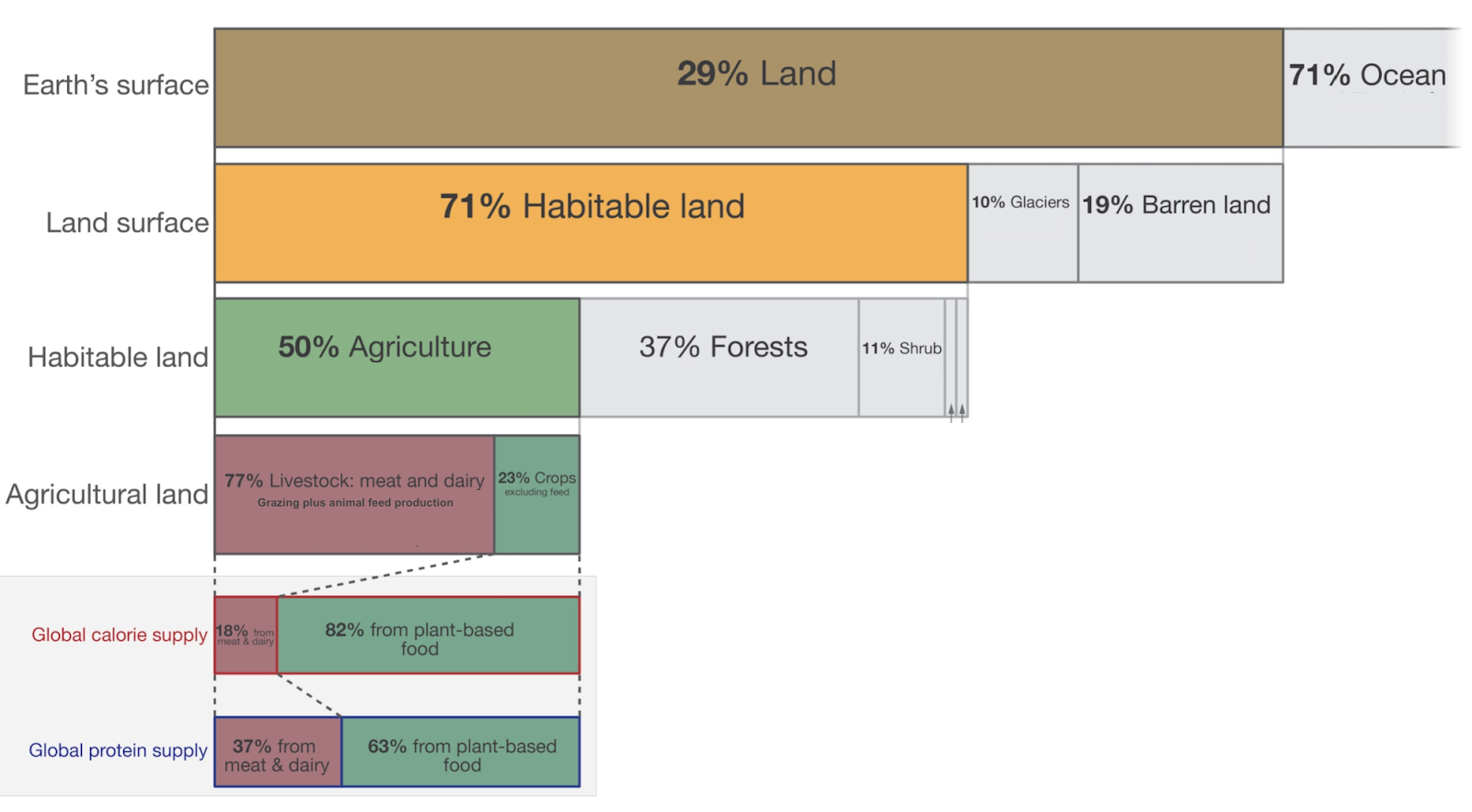
As Fig.1 shows, animal agriculture takes up a massive proportion of the world’s habitable land and the bulk of the agricultural land, but it supplies only 18% and 37% of the world’s calories and protein respectively, meaning it is very inefficient.
Fig.1 – Global land use for food production6
Compared to agriculture as a whole, animal agriculture consumes a disproportionate amount of land and fresh water, and causes the majority of air and water pollution.7 It is also the biggest cause of species extinction, ocean dead zones and habitat destruction.8
Of these many dreadful effects, I think greenhouse gas emissions is the most important to focus on, because the IPCC is warning that without drastic action we are heading for a future 3-degrees hotter, with potentially catastrophic effects on ecosystems, food security, sea levels, migration and wars. The window to take effective action is rapidly narrowing, so it is extremely urgent.9
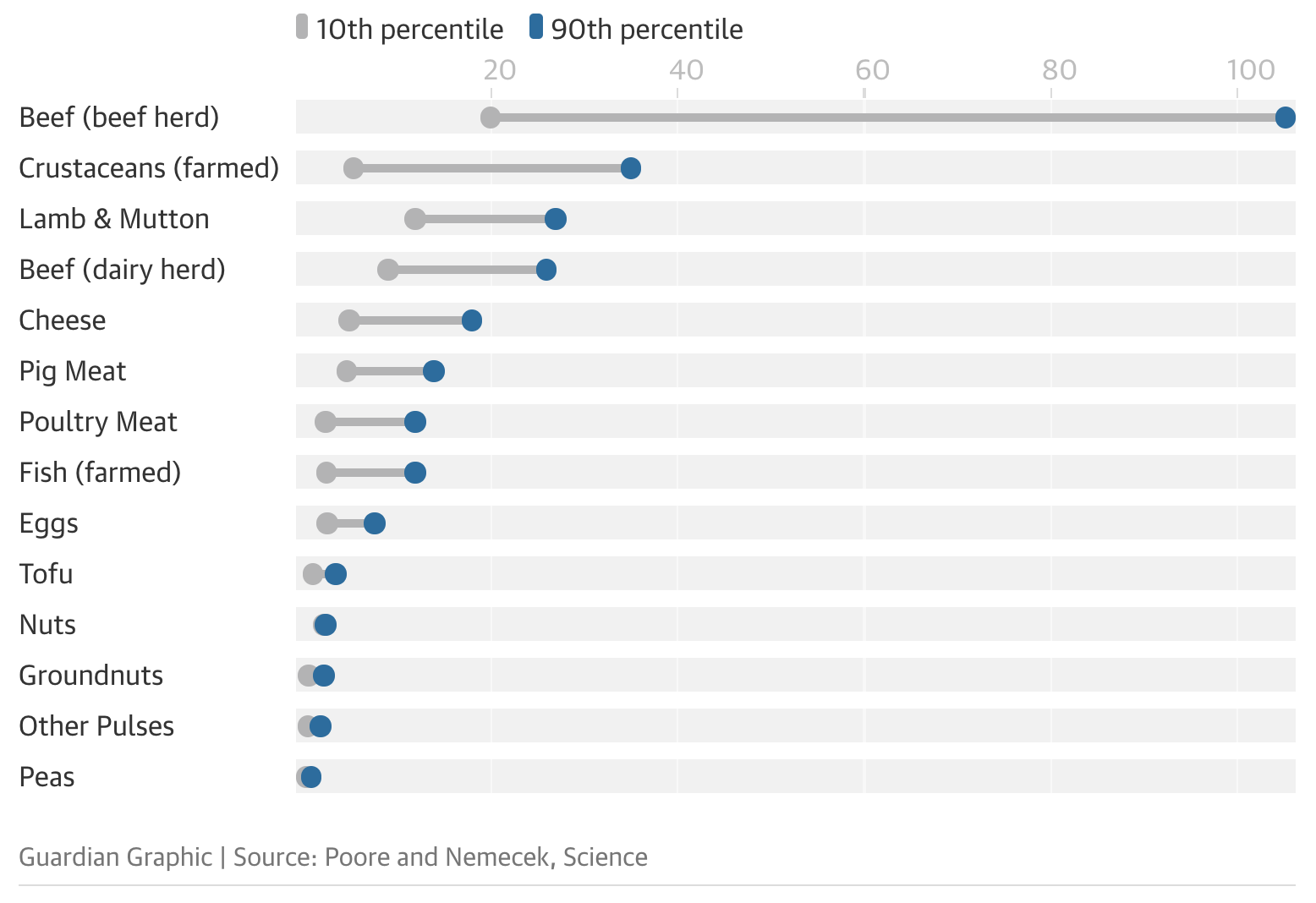
The IPCC says there is “significant potential” to mitigate climate change by adopting healthy diets high in plant-based foods and low in animal-sourced foods worldwide.10 According to Poore’s study, even just reducing animal agriculture by 50% while targeting the worst producers would reduce total GHG emissions by 20%.11 That is more than emissions from all transport (16%) or all energy use in buildings (17.5%).12 GHG savings from those will need massive investment in infrastructure and technology and will take a long time. In contrast, the plant-based proteins to replace animal-sourced ones make far lower GHG emissions (Fig.2) and could be grown cheaply using just a little of the 3.5 billion hectares13 of land saved from animal agriculture.
Fig. 2: a comparison of the carbon emissions from producing equivalent quantities of protein14
Poore’s personal perspective must be one of the best-informed in the world. He says: “‘A vegan diet is probably the single biggest way to reduce your impact on planet Earth.”15
Is this perspective from the UN and from science being adopted by nations? — Not very well! Governments around the world are missing the opportunity to promote the lowest-carbon lifestyle choices, according to a 2017 study.16 I confirmed this was true for my country, the UK — in the 135-page document that explains its plan to achieve “net zero” emissions by 2050 I could find no mention of diet whatsoever.17 Unsurprisingly, the government is being sued by environmental campaigners for failing to create an adequate plan.18
For balance, I sought out the perspective of the animal agriculture industry. The global industry does not speak with a single voice, but since the USA produces and consumes far more meat than most other countries,19 I looked to the largest USA industry lobby group “Animal Agriculture Alliance” (AAA) for a representative perspective supporting animal-sourced foods. The AAA claim that the industry’s environmental impact is widely exaggerated, and that improving efficiency with technological innovations is enough environmental action, without cutting down on production.20
However, I was not persuaded that the AAA is a good source of information. The website spins facts to support the industry, e.g. telling “Meat & Milk’s Sustainability Story” entirely by percentage improvements in efficiency,21 which hides the fact that high growth has caused overall environmental impact to rise. The AAA’s claim that the industry can reduce its environmental impact just by increasing efficiency is wrong because people will buy more when the product gets cheaper – an effect known as “price rebound”.22 Overall therefore, this perspective seems highly distorted by vested interest and tries to maintain business as usual by giving false reassurances.

[Group of Zebu calves grazing in recently deforested land in the Amazon, Brazil.]
Causes of production and consumption of animal-sourced foods
If vegan foods offer such an environmentally beneficial alternative to meat, dairy and seafood, why are there so few vegans? Why is consumption of animal-sourced foods so high, and why aren’t governments and mainstream environmental groups persuading us to switch to plant-based foods?
One reason is that the livestock industry is very powerful and intimidates its opponents. In South America, many campaigners have been murdered.23 In countries with stronger rule of law such as the USA, critics can be sued24 under laws that protect the industry by restricting freedom of speech.25 The powerful industry lobby also influences the government to subsidise the cost of production, e.g. by hunting predators and granting grazing on common land.26 One study finds that if the externalised costs of meat production in the USA had to be included, the price would more than double.27
Food supply is big business, so countries with large natural resources have an opportunity to exploit them to create wealth, regardless of sustainability. “You have to understand that the Amazon is Brazil’s, not yours,” said President Bolsonaro in 2019,” citing what he sees as hypocrisy from overseas environmentalists: “You destroyed your own ecosystems.”28 Believing two wrongs make a right, Bolsonaro has engineered a boom in Brazil’s beef and pork exports, causing huge additional damage to the Amazon rainforest.29
Global economic growth has expanded the number of people who can afford meat, and animal-sourced foods symbolise prosperity and status,30 so people eat more as they get wealthier. China is the most spectacular example in recent years. China ate 5kg of meat per person per year in 1960 and eats 63kg today.31 Unlike others, this is not a cause we would want to reverse, but it points to the frightening prospect of massive additional environmental impact if billions more people follow this trend when they make it out of poverty.
The widespread belief that meat and dairy are nutritionally essential is a major driver of consumption. It is not supported by the UK’s National Health Service, which voices national policy on health and nutrition: “As long as they get all the nutrients they need, children can be brought up healthily on a vegetarian or vegan diet.”32 Cultural beliefs like this require time and education to shift, so it is disappointing to see that the UK government’s “Eatwell Guide” infographic33 only weakly acknowledges plant-based alternatives.
In contrast, China’s government has recently set a goal of halving meat consumption by 2030, and is encouraging innovation and growth in the mock meat industry.34 China’s Buddhist heritage may make it more culturally willing to embrace meat substitutes, and it is starting to view meat as risky, as the origin of diseases such as avian flu and COVID.35 Cost is still a significant barrier to mass uptake, and good plant-based meat is still more expensive than animal meat, but China’s active government backing will help create the mass production which will bring down costs.36
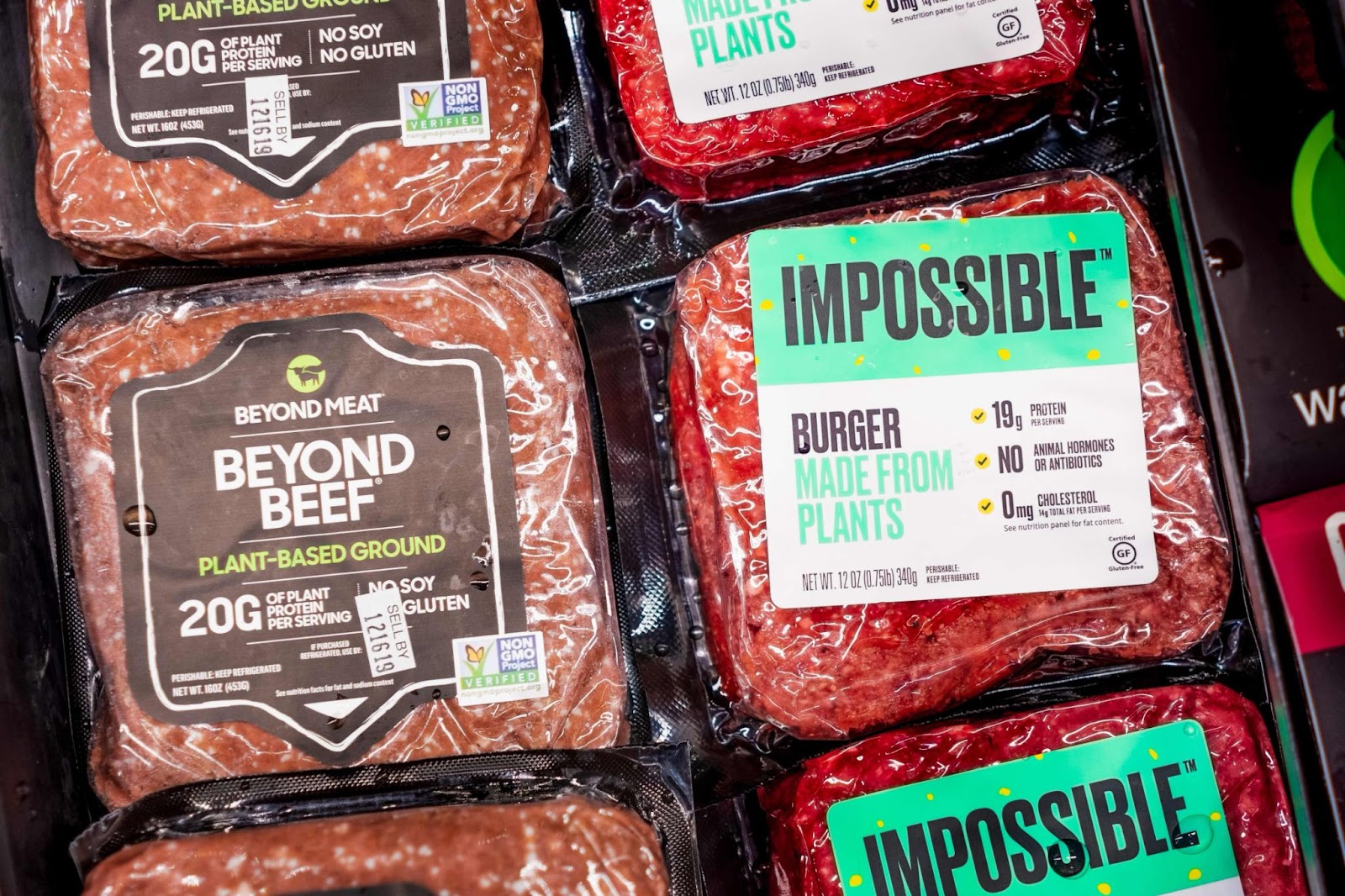
Taste is another key cause, but recently I have personally noticed huge improvements in plant-based meat and dairy substitutes, from companies such as Omnifoods, Impossiblefoods, and Beyond.37 Growing rapidly, such companies intend to take market share from animal agriculture.38
Which causes of meat consumption should we focus on? Some, like bullying and lobbying by the animal agriculture industry seem unjust, selfish, negligent, or even criminal, which motivates us to demand action against them. However, it is hard to challenge powerful vested interests, so in the search for a solution it may be better to consider the price and taste of substitute foods as the most important factors because once the technology improves it will spread globally and tend to weaken demand for animal-based foods naturally. Cultural factors are also critical because they will strongly affect people’s willingness to eat different foods.
Conclusions and reflection on the development of my personal perspective
Should we stop eating animal-sourced foods? – Yes, my investigation shows that they cause massive environmental harm, yet I found no reasons humanity couldn’t thrive without them. I was astonished to find that despite such a high impact on climate change, reducing animal agriculture is not yet prominent in climate action plans. I also realised that alternative climate actions such as travelling less would diminish our lives far more.
As a vegetarian myself, I was vulnerable to confirmation bias during this investigation, and I realised the need for patience and empathy when reading sources that opposed my views. The AAA website did not change my opinion, but it did help me to see how destructive their opponents must seem from their perspective, so I understood the need for support to help people transition their livelihoods out of animal agriculture. It made me wonder whether I am equally critical when I read information that supports my views, which prompted me to make extra effort to check facts.
Suggested course of action
Because of the urgency for climate action, I think only government policies can drive the necessary widespread change fast enough. All national governments should accept the IPCC’s message and effectively plan a switch to low-carbon plant-based diets. China’s 50% meat reduction policy is a good example to follow. To achieve this, government education materials like the UK’s “Eatwell Guide” should be updated to actively promote plant-based foods. Vegan food producers should receive tax breaks, and meals funded by the government (in schools, canteens for civil servants, etc.) should make the switch to increase demand. This will boost development of ever more attractive plant-based foods, and economies of scale to bring down their prices. Because culture and habits take time and effort to change, the government should also enlist the help of opinion leaders such as celebrity chefs to develop new, culturally attractive vegan dishes. Governments will need to help people switch their livelihoods from animal agriculture to the new opportunities which will arise, and should buy up surplus agricultural land for rewilding as carbon sinks.
Creating new national parks and restored ecosystems to enjoy, plus delicious new alternative foods to eat, this policy will have an overwhelmingly positive impact besides reducing climate change.
Word count
Body: 1910 words; within Fig 1: 62 words; within Fig 2: 28 words. Total: 2000 words
Citations
1 Foer, J. Eating Animals. First Back Bay paperback edition. New York: Back Bay Books, 2010. Print.
2 Wikipedia, “Vegetarianism By Country” https://en.wikipedia.org/wiki/Vegetarianism_by_country#Demographics, accessed 2 Feb 2022
3 Goodland, R Anhang, J. “Livestock and Climate Change: What if the key actors in climate change were pigs, chickens and cows?” https://awellfedworld.org/wp-content/uploads/Livestock-Climate-Change-Anhang-Goodland.pdf accessed 2 Feb 2022
4 Poore & Nemecek (2018) Reducing food’s environmental impacts through producers and consumers, https://josephpoore.com/Science%20360%206392%20987%20-%20Accepted%20Manuscript.pdf accessed 2 Feb 2022 and erratum https://pubmed.ncbi.nlm.nih.gov/30792276/ accessed 2 Feb 2022
5 Ibid.
6 The Guardian, 31 May 2018, Avoiding meat and dairy is ‘single biggest way’ to reduce your impact on Earth https://www.theguardian.com/environment/2018/may/31/avoiding-meat-and-dairy-is-single-biggest-way-to-reduce-your-impact-on-earth accessed 2 Feb 2022
7 Data source: UN Food and Agriculture Organisation, graphic from Our World in Data website: https://ourworldindata.org/global-land-for-agriculture accessed 28 Jan 2022
8 Poore & Nemecek (2018)
9 UN Intergovernmental Panel on Climate Change 6th Report, https://www.ipcc.ch/report/ar6/wg1/#SPM, accessed 1 Feb 2022
10 UN Intergovernmental Panel on Climate Change, Special Report on Climate Change and Land, Executive Summary “5.6.3.1 Can dietary shifts provide significant benefits?” https://www.ipcc.ch/srccl/chapter/chapter-5/ accessed 25 Jan 2022
11 Poore & Nemecek (2018) erratum https://pubmed.ncbi.nlm.nih.gov/30792276/
12 Our World in Data website: “Sector by sector: where do global greenhouse gas emissions come from?” https://ourworldindata.org/ghg-emissions-by-sector accessed 31 Jan 2022
13 Our World in Data website: “If the world adopted a plant-based diet we would reduce global agricultural land use from 4 to 1 billion hectares” https://ourworldindata.org/land-use-diets accessed 2 Feb 2022
14 Data source: Poore & Nemecek (2018). Graphic from The Guardian, 31/04/2018, accessed 31 Jan 2022
15 Ibid.
16 Wynes, S. and Nicholas, K. 2017 Environmental Research Letters, “The climate mitigation gap: education and government recommendations miss the most effective individual actions”, https://iopscience.iop.org/article/10.1088/1748-9326/aa7541, accessed 31 Jan 2022
17 UK Government: HM Treasury, “Net-Zero Review”, October 2021, https://assets.publishing.service.gov.uk/government/uploads/system/uploads/attachment_data/file/1026725/NZR_-_Final_Report_-_Published_version.pdf accessed 2 Feb 2022
18 The Guardian, 12 Jan 2022, “UK government sued over ‘pie-in-the-sky’ net-zero climate strategy”, https://www.theguardian.com/environment/2022/jan/12/net-zero-climate-strategy-uk-government-sued accessed 2 Feb 2022
19 OECD Data: “Meat Consumption”, https://data.oecd.org/agroutput/meat-consumption.htm accessed 2 Feb 2022
20 Desmog.com, “Animal Agriculture Alliance”, https://www.desmog.com/agribusiness-database-Animal-Agriculture-Alliance/ accessed 2 Feb 2022
21 Animal Agriculture Alliance website, “Sustainability”, https://animalagalliance.org/issues/sustainability/ accessed 2 Feb 2022
22 UN Intergovernmental Panel on Climate Change, Special Report on Climate Change and Land, Executive Summary “5.6.3.1 Can dietary shifts provide significant benefits?” https://www.ipcc.ch/srccl/chapter/chapter-5/ accessed 25 Jan 2022
23 The New York Times, 21 June 2016, “The Rising Murder Count of Environmental Activists.” https://www.nytimes.com/2016/06/21/science/berta-caceres-environmental-activists-murders.html accessed 2 Feb 2022
24 Reporters Committee for Freedom of the Press website: “Appeals court upholds win in ‘mad cow’ lawsuit”, from Spring 2000 issue of The News Media & The Law https://www.rcfp.org/journals/the-news-media-and-the-law-spring-2000/appeals-court-upholds-win-m/ accessed 22 Jan 2022
25 Andersen & Kuhn, “Cowspiracy” 2022 version, https://www.youtube.com/watch?v=PfmpXM7TADU accessed 21 Jan 2022
26 Ibid.
27 Ibid.
28 The Guardian, 19 July 2019, “Bolsonaro declares ‘the Amazon is ours’ and calls deforestation data ‘lies’” https://www.theguardian.com/world/2019/jul/19/jair-bolsonaro-brazil-amazon-rainforest-deforestation accessed 2 Feb 2022
29 The Guardian, 16 March 2021, “Eating up the rainforest: China’s taste for beef drives exports from Brazil”, https://www.theguardian.com/environment/2021/mar/16/eating-up-the-rainforest-chinas-taste-for-beef-drives-exports-from-brazil accessed 31 Jan 2022
30 United Nations, Academic Impact: “Shifting to Sustainable Diets” https://www.un.org/en/academic-impact/shifting-sustainable-diets, accessed 2 Feb 2022
31 Time, Jan 22, 2021: “How China Could Change the World by Taking Meat Off the Menu”, https://time.com/5930095/china-plant-based-meat/, accessed 2 Feb 2022
32 UK National Health Service website: “Vegetarian and vegan diets Q&A”, https://www.nhs.uk/live-well/eat-well/vegetarian-and-vegan-diets-q-and-a/ accessed 31 Jan 2022
33 UK Government, Public Health England, “The Eatwell Guide” https://www.gov.uk/government/publications/the-eatwell-guide accessed 31 Jan 2022
34 Time, Jan 22, 2021: “How China Could Change the World by Taking Meat Off the Menu”, https://time.com/5930095/china-plant-based-meat/, accessed 2 Feb 2022
35 Ibid.
36 Ibid.
37 Own experience
38 MSN News: “Impossible Foods Prepares To Go Public At Around $10B Valuation: Report” https://www.msn.com/en-us/money/news/impossible-foods-prepares-to-go-public-at-around-10b-valuation-report/ar-BB1ft0qO accessed 27 Jan 2022
Works Cited (separate document)
Commendable job
indeed
really good work
which citation style is this?
I used Easybib to build this citations list. I think I used MLA. CAIE don’t mind which standard you use, but they assess it for “consistency”.
Very useful! In my school we use APA format for citations.
Who else is watching this to write an individual report assignment at 3AM
Shouldn’t use wikipedia
It really depends what you use Wikipedia for. It may be open access, but it does have a community of editors who care deeply about accuracy and academic integrity. I have just noticed this video from Mike Caulfield of the University of Washington’s Center for an Informed Public, in which he uses Wikipedia as a prima facie guide to the nature of an organisation and thus the likely credibility/bias of its website. There is little reason to fear misinformation from the Wikipedia page, given the comparatively low stakes and uncontroversial nature of the query. There are certainly other times when Wikipedia would not be a sufficiently authoritative source. However, Caulfield is talking about the evaluation of sources appropriate for members of the public as they form their views on issues, and that is about the level of IGCSE.
How much time did you spend on this report? also amazing job
Is it acceptable to use Wikipedia as a source? Since it can be edited by anyone, I was under the impression that it might not be reliable.
Good question, Zaufishan. It depends what you want to use it for. If it’s for critical or controversial information you’d certainly want to back it up with other sources. However, Wikipedia pages are guarded by a huge team of volunteer editors who care about its accuracy and strive for high standards, so it’s a pretty good source of information overall.